
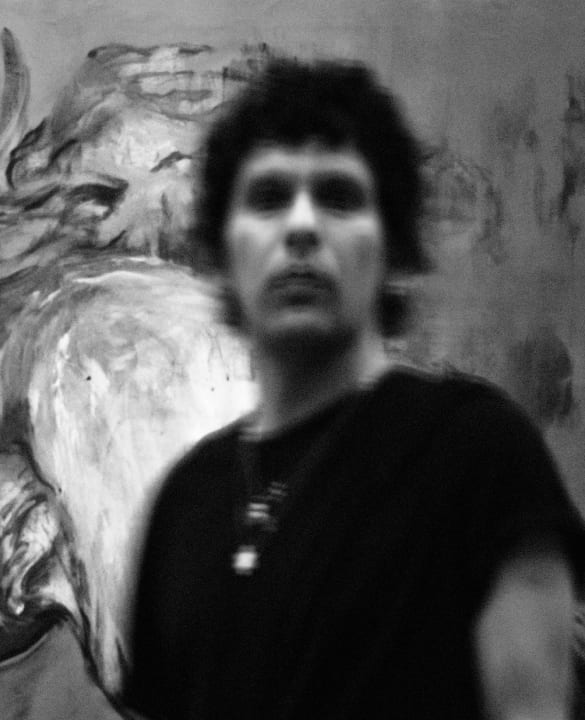
Irving Ramó (b. 1989, Quito, Ecuador, based in Berlin. Explores cycles of power and the shifting roles of victim and aggressor. His work fuses historical iconography with contemporary tension, turning the painting into a ritual arena where desire, violence, and mortality intertwine.
Across his ongoing exploration of the equestrian figure, Ramó revisits classical equestrian portraiture as a looping, ironic spectacle, questioning heroism, migration, and masculinity. Figures multiply and lose their singularity, hovering between myth and memory, tragedy and play. Through color, form, and repetition, Ramó suspends the viewer in a world both unsettling and strangely familiar.
His work investigates tragedy and conflict as fundamental structuring forces. He envisions a cycle in which the roles of victim and aggressor are constantly reversed. By juxtaposing diverse traditions and iconographies, his pieces generate symbolic tensions that expose the interplay of desire and violence, as well as the enduring cycles of power, perpetually reimagined in new forms. Many of his works incorporate structural elements that transform the canvas into a ritual arena, where conflict, eroticism, and death converge.
- - -
Tickets for the arts programme and performances are available either with an ALL PASS (Weekend Pass for Rave, Dance, Concert & Culture) or at the door of the arts programme venue at PERGALĖ factory.
Art programme ticket for one day – 10 Eur.
Art programme ticket for whole weekend – 15 Eur