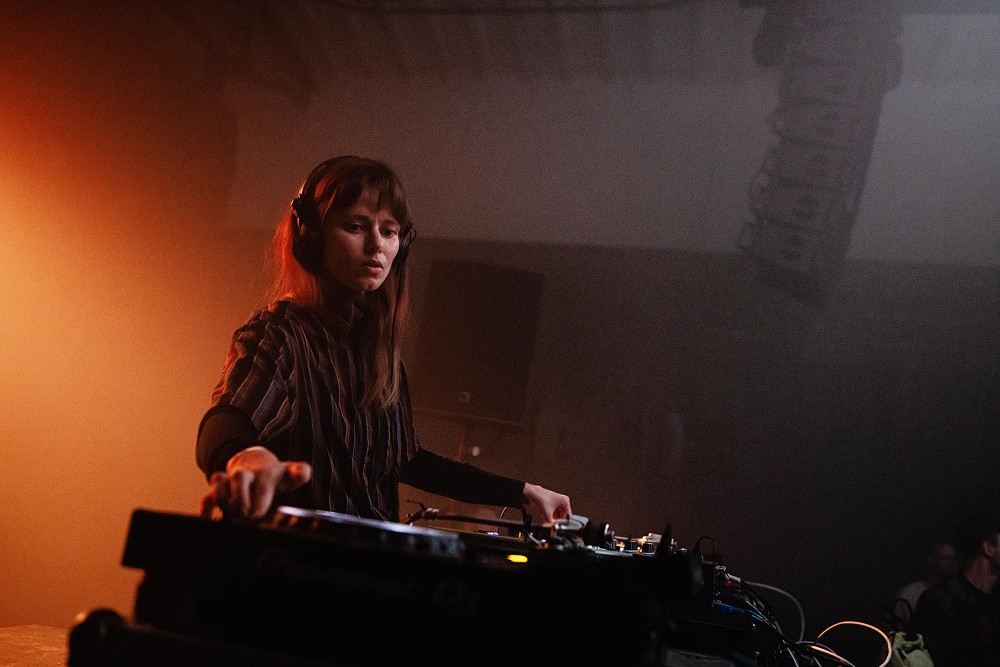
Aistė Regina Kliveckaitė has been active on the electronic music scene for eight years. Back in her school days, re-recorded cassette tapes, newly discovered bands, sneaking into nightclubs, and a fateful request from a friend to step behind the decks herself have today turned into a way of life.
On March 27, Aistė’s crafted atmosphere of dance music will be experienced in Vilnius at the Contemporary Art Centre, where AUDRA will take over the space for one night. As the event approaches, the artist speaks about her years-long modeling career, festival and nightlife culture, her first musical experiences, and creating in a male-dominated field.
Aistė, what stage of life are you in today? Eight years on the electronic music scene – is that a lot or a little? How have you and your perspective on music culture changed over that time?
I am in constant evolution – regardless of the field or the season. Only the styles and pace of growth change, depending on the environment and its influence. At this particular stage, I am growing through the world of music.
I imagined fewer than eight years had passed. I’ll admit – I felt a sense of satisfaction: in my life, it feels like a lot. In the industry? Very little. Still, I now stand alongside professionals who have been doing this twice as long, and some close friends on the scene – even three times longer. I became a resident not only at the essential Vilnius club Gallery 1986, but I also travel the world with music. I have played in New York, Mexico, Berlin, Kyiv, Guatemala, France, and beyond.
Lately, I’ve been experiencing especially strong emotions through my work. The accumulated practice and muscle memory allow me to relax – which creates space for creative decisions in the moment. That’s true pleasure. Over the years, my skills have sharpened; I’ve moved through various genres in search of myself. My attitude has evolved too – from carefree to professional.
It’s no secret that you also spent years in the fashion industry working as a model. What joys, experiences, or connections kept you in that world for so long?
Fashion, as an art form, was never my passion, which made the work challenging. What I loved was traveling: learning languages, exploring countries and cities, discovering cultures and people around the world. Becoming independent early, learning survival skills, achieving financial independence – it brought both responsibility and freedom.
Yet I always longed for meaning, something I couldn’t find in fashion or conversations about it. I tend toward alternative thinking – and in the polished beauty industry of that time, there was little space for it. Of course, I understand and appreciate fashion. I enjoy dressing well, creating a distinctive style, observing how it changes (much like in music), collecting and rotating clothes.
Modeling and DJing actually share similarities: travel, stage presence, trends, competition, constant movement. I increasingly see parallels between the two as creative fields.
From the outside, modeling looks glamorous. In reality, it’s harsh – physically and psychologically demanding. You’re expected to be perfect every day, to maintain a “natural” beauty that’s often harder to sustain than something artificial. Endless hours on your feet, in heels, in freezing temperatures wearing a bikini, in heat wearing fur – and constant criticism of your appearance.
I worked as a model for many years because when you’re fifteen and suddenly spend a summer in Milan, Paris, Tokyo, or London, you gain experiences that don’t match your age. Over time, you lose track of who you are. While your peers are deciding what to study or how to build their future, modeling makes those decisions for you. Many girls become consumed by the role, losing their sense of self. Later, it’s difficult to change careers – lacking ordinary life skills, work experience, degrees, or financial equivalents elsewhere.
Somehow, I managed to finish my studies and keep searching for more. Leaving modeling took over three years. I had no idea what I would do once I cut ties with agencies worldwide and was left with nothing but beautiful photographs. I had to close that chapter completely in order to open my eyes to a new life.
How did music enter your life? Was it a sudden turning point, or did it develop organically alongside your other activities?
It always seemed like music struck suddenly and unexpectedly. But when I begin to wander through the details of my life, it becomes clear that it accompanied me all along: from childhood studies at Balys Dvarionas School of Music, to recording mixtapes from songs playing on the radio onto cassette tapes – which I would later play at school discos – to searching for music on various platforms, organizing rave parties and events, and finally arriving where I am now.
Nightlife, clubs, festival culture – when did all of this enter your life? Do you remember a specific evening, festival, or rave that “switched something on” in you – the desire not only to observe, but to create and stand on stage yourself?
I always enjoy telling this “switch” story: the Underworld concert in 2006 at Litexpo Exhibition Centre. I won the tickets on the radio. The concert took place mid-week, and the next morning I had a math test. I remember how difficult it was to concentrate – my thoughts kept drifting back to the music and the legend I had experienced that night. I already knew Underworld because I had begun exploring electronic music alongside my love for hip-hop. Soon I began sneaking into the club “Gravity.”
Not long after, thanks to my then boyfriend, I joined the organization of underground, true rave parties and festivals, balancing this at times with modeling and traveling abroad. Heavy-sounding drum’n’bass, breakcore, and hard techno shaped a significant part of my understanding of electronic music, even though today I belong to the house scene.
A long-standing friendship with Lithuanian electronic music master Manfredas Bajelis also gave me meaningful influence.
The decisive adventure of stepping behind the decks came from my close friend Vytautas Navickas, who encouraged me to play one evening at “Zuikio Daržas,” where I was curating the musical program and developing the venue’s identity. Despite years spent around DJs and parties, I thought he was crazy. I had no idea how the equipment worked. Yet not only did it go surprisingly well – it felt as though the spirit of music opened a door and showed me what I could do. And that continues.
In your opinion, has nightlife and festival culture changed in recent years? Is it true that audiences increasingly seek comfort and convenience, and are less willing to commit to tents and multi-day gatherings?
Of course it is changing – that is evolution. Whether the changes are good or bad shouldn’t be judged too quickly, otherwise we risk becoming nostalgic complainers, stuck in one genre or one era. What may seem negative today could, in a decade, give birth to something new and meaningful. Phenomena go through “bad” phases so that people can later rediscover what is fundamental and real.
For example, we might feel that we’ve become overly immersed in technology – yet perhaps, returning from those laboratories with new knowledge, we will build festivals that are less harmful to nature while remaining just as impressive. And right now, we have a strong example of conceptual transformation on the horizon – the city festival AUDRA.
I adore camping and multi-day gatherings in nature. It saddens me that, as people change, fewer experience that particular state of consciousness. Nature festivals have developed entire philosophies: for several days or even weeks, separate socio-eco systems – micro-worlds – are created. In some of them, money or phones cease to exist, but unwritten laws, shaped over years, take over. Like Wi-Fi, you automatically connect to them the moment you enter the festival grounds.
There’s a capacity to survive in a kind of gentle discomfort, where a festival-goer may need community support for the simplest tasks, and in that process there is less space for ego – people operate in harmony. It’s very beautiful.
Last summer I went to the wonderful Ezera Skanas festival in Latvia, where everything is hand-built: surreal constructions, floating stages, columns holding canopies above turntables, inspired by the reflection of reeds in the lake. It might appear very hippie or DIY at first glance, but in fact – without major commercial sponsors – skilled urban professionals, architects, advertising producers, doctors, artists, create a temporary utopia with deep passion and experience. A space where we can genuinely live differently for a while.
Of course, when we speak about broader audiences – those less alternative in their habits – perhaps nature-based consciousness hasn’t yet formed. Maybe that’s not entirely bad; I’m not sure everyone would respect the living forest, lake, fire. Still, I would wish for every music lover to experience it at least once and expand a one-directional mindset.
You’ve spent many summers in Nida. What makes this place special to you? What does it mean for your creativity, rhythm, and inner state?
With the demolition of places like “Zuikio Daržas” and “Kaštonas,” and the disappearance of other non-commercial spaces, I feel that Nida, at least for now, is in a kind of pause – perhaps even an ending.
For decades, since the 1960s, hippies, artists, poets, and musicians travelled there seeking magic and inspiration. They shaped the character of the people who visited that land. Strange places for strange souls emerged, where anyone could find refuge. In the “Zuikio Daržas” community, I learned to accept everyone – children, elders, ravers, classicists, thinkers, craftsmen, hitchhikers, people arriving in luxury cars. Everyone.
Now it seems that one dominant layer prevails there – less open to the other or the different. I find that boring. But again, we are speaking about metamorphosis – everything will change again in time. For now, it feels less cozy. The one eternal and majestic presence is the nature of Neringa. That is what I always return for.
I’ve spent around twelve summers there – sometimes spring and autumn as well – and Nida truly shaped who I am. The way I see life, often in explosive sunset colors; the way I react to situations, from stillness to storm; the way I sense people – hosting guests every single summer day; the way I approach challenges – like organizing large weekend beach dances; and the fact that I most love playing open-air sets. Certain sounds still awaken sacred emotions tied to life by the sea.
Interestingly, life created a beautiful transition, and now I sometimes spend summers in Palanga. I won’t elaborate too much, but what fascinates me is that different communities coexist there. Compared to Nida, there are more cultural events, more accessibility, and a larger community. And there’s a wonderful local market, too.
AUDRA is a city festival. Are the pulse and life of the city close to you? What connection do you have with Kaunas and other cities?
I am a Vilnius native who loves nature, the seaside, and deeply loves Kaunas. Whether in sneakers or barefoot, in abandoned factories or deep in the forest, I feel comfortable.
Kaunas always excites me whenever I travel there to play or visit friends. The AUDRA festival is yet another proof that Kaunas’ electronic scene creators – many of whom are my friends – are extraordinary operators. Their events are consistently sophisticated and intriguing; their level of quality can be intimidating in the best way.
Kaunas’ architecture and buildings contribute greatly – sometimes it feels like there are more unique spaces there than in the capital. Not to mention that the crowd on the dance floor sets its own rules.
How do you feel as a woman on the music scene? Is it still a male-dominated world, or is something changing? Have you encountered stereotypes or attitudes suggesting “this is not your place”?
Most fields are still dominated by men. We’ve lived in such a civilization for millennia. Masculine energy – which all genders possess to varying degrees – is powerful and builds houses, ships, entire cities. In a world that worships material production, those who create and control matter naturally dominate.
Feminine qualities – empathy, generosity, grace, intuition, care, community – are still undervalued because they don’t directly serve consumption or profit. Many women themselves remain conditioned by old programming: “be good, don’t risk, don’t interfere, stay in your place.” That inherited system is difficult to erase, even across generations. Hence, imbalance persists.
It is time to understand that these qualities are equally necessary for balance and for building a beautiful world. I believe we are already stepping into new times where long-ignored abilities are gaining recognition.
On a more practical level – yes, various situations occur. Sometimes I must stand my ground, either by ignoring meaningless machismo or by responding clearly so boundaries are understood. The music scene is, in many ways, a more sensitive environment – full of feeling people and artists – which allows space for dialogue. But systemic exclusion spanning centuries is difficult to grasp if you haven’t experienced it. Only consistent conversation and education can shift awareness.
Is there a life philosophy or motto that accompanies you in everything you do?
Evolution, which I mentioned at the beginning, is each person’s inner work – often invisible – yet what we can give to the world comes from within. Life brings many challenges and resistance. Some things come more easily to some, and harder to others. Let us understand one another and be willing to change, so that each day we live a little more interestingly. It is an endless journey.